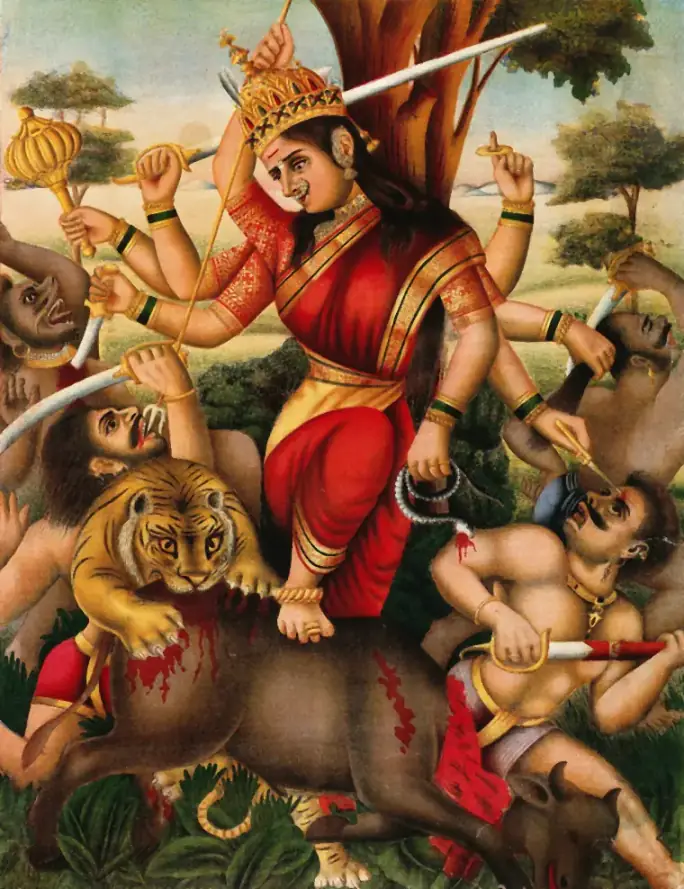
When the gods themselves could not defeat evil, they turned to the Mother. Durga, whose name means “the one who is hard to reach” or “the invincible”, is the fierce and loving form of Shakti, the divine power behind all creation. To her devotees she is simply Maa: gentle to her children, terrifying to anything that would harm them.
The story of Mahishasura
The demon Mahishasura, who could change between human and buffalo form, won a boon that no man or god could kill him. Proud of his power, he drove the devas out of heaven. In their anger, the light of Brahma, Vishnu, Shiva and all the gods combined into one blazing form: the goddess Durga.
Each god gave her a weapon, the Himalaya gave her a lion to ride, and she went into battle. The fight lasted nine days and nights. On the tenth day she struck down Mahishasura, which is why she is called Mahishasuramardini and why the tenth day, Vijayadashami, is celebrated as the victory of good over evil.
What her symbols mean
- The lion: power held under control, and courage that does not panic.
- The trident (trishul): mastery over the three qualities of nature: sattva, rajas and tamas.
- The lotus in one hand: even in battle, her heart stays pure and open.
- Her calm face: she fights without hatred, out of love for the world.
How to worship Durga at home
- On a Tuesday, Friday or during Navratri, place her picture on a red cloth.
- Offer red flowers (especially hibiscus), kumkum, a red chunri, and a coconut or sweets.
- Light a ghee diya; in Navratri many families keep an akhand jyoti burning for all nine days.
- Chant ॐ दुं दुर्गायै नमः or the Durga Chalisa, and on special days read from the Durga Saptashati.
- Sing “Jai Ambe Gauri” and end with the prasad. On Ashtami or Navami, many families worship young girls as the goddess (kanya pujan).
Festivals and famous temples
Sharad Navratri and Chaitra Navratri are her great festivals, and in Bengal, Assam and Odisha the last five days are celebrated as Durga Puja with magnificent pandals. Her best-known shrines include Vaishno Devi in Jammu, Kamakhya in Guwahati, Kalighat in Kolkata, Ambaji in Gujarat, Chamundeshwari in Mysuru, Naina Devi and Jwala Ji in Himachal Pradesh, and the many Shakti Peethas across the subcontinent.
Other names of Durga
The Durga Saptashati praises the goddess in countless forms, and she is worshipped with 108 names. Her nine Navratri forms, the Navadurga, each have their own page.
| Name | नाम | Meaning |
|---|---|---|
| Durga | दुर्गा | The invincible one, hard to reach |
| Ambe | अम्बे | Mother |
| Jagdamba | जगदम्बा | The mother of the world |
| Sherawali | शेरावाली | The one who rides the lion |
| Bhavani | भवानी | The giver of life |
| Adi Shakti | आदिशक्ति | The primordial power |
| Mahishasuramardini | महिषासुरमर्दिनी | The slayer of Mahishasura |
| Chandi | चंडी | The fierce one |
| Gauri | गौरी | The fair one |
| Parvati | पार्वती | The daughter of the mountain |
| Kali | काली | The dark one, beyond time |
| Katyayani | कात्यायनी | The daughter of the sage Katyayan |
Goddess Durga: common questions
What are the nine forms of Durga worshipped in Navratri?
The Navadurga, one for each night of Navratri, are: Shailaputri, Brahmacharini, Chandraghanta, Kushmanda, Skandamata, Katyayani, Kalaratri, Mahagauri and Siddhidatri.
When is Navratri?
The main Navratri is Sharad (Shardiya) Navratri, the nine nights from Ashwin Shukla Pratipada, usually in September or October, ending with Vijayadashami (Dussehra). Chaitra Navratri in March or April ends with Ram Navami. There are also two Gupt Navratris in Magha and Ashadha.
Why does Durga have ten arms?
Each of the gods gave the goddess their weapon to fight Mahishasura, so her many arms hold Shiva's trident, Vishnu's discus, Indra's thunderbolt, Varuna's conch, Agni's spear, Yama's club, Vayu's bow and arrows, and more. The ten arms show that she protects from every direction.
What is Durga Saptashati?
Durga Saptashati, also called Devi Mahatmya or Chandi Path, is the 700-verse scripture from the Markandeya Purana that tells the stories of the goddess's victories over Mahishasura, Shumbha-Nishumbha and other demons. It is recited during Navratri.