For many Hindus, Shiva is the god who is easiest to please, which is why he is lovingly called Bholenath, the innocent lord. A lota of water poured on the Shivling, a few bel leaves and a sincere Om Namah Shivaya are said to be enough. Yet the same Shiva is Mahakal, lord of time, whose cosmic dance ends one age of the universe so that a new one can begin.
Who is Lord Shiva?
Shiva is one of the three great gods of the Trimurti. Brahma creates, Vishnu preserves and Shiva dissolves. Dissolution here does not mean cruelty; it means clearing away what is old so that renewal can happen, the way winter makes room for spring.
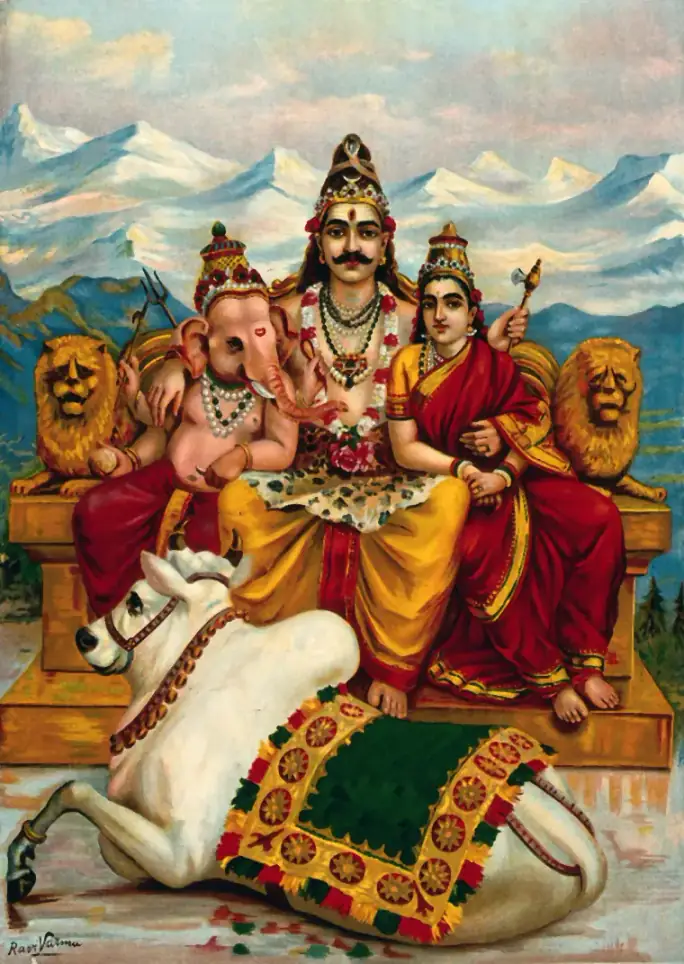
He lives on Mount Kailash with his wife Parvati, their sons Ganesha and Kartikeya, and his devoted bull Nandi, whose statue faces the sanctum in every Shiva temple. In the painting above, the whole family sits together on Kailash.
The meaning of Shiva’s symbols
- Crescent moon on his head: mastery over time, which waxes and wanes.
- River Ganga flowing from his hair: he broke her mighty fall from heaven so the earth would not be destroyed.
- Third eye: the eye of wisdom that burns away ignorance and desire.
- Trishul (trident): the three qualities of nature (sattva, rajas, tamas), all under his control.
- Damru (drum): the rhythm from which, it is said, sound and language were born.
- Serpent around his neck: fearlessness; what frightens others is an ornament to him.
- Bhasm (ash): a reminder that everything physical returns to ash, and only the soul remains.
- Blue throat: the poison he drank to save the world, which is why he is Neelkanth.
How to do Shiv puja at home
- Early on a Monday, bathe and wear clean, preferably white clothes.
- Place a small Shivling or a picture of Shiva on a clean cloth.
- Pour water, or water mixed with a little milk, over the Shivling while chanting ॐ नमः शिवाय. This is abhishek.
- Offer bel patra (three-leaf bael leaves, with the smooth side touching the Shivling), white flowers and a pinch of bhasm or chandan.
- Light a ghee diya and dhoop, and offer fruit or mishri as prasad.
- Sing the aarti Om Jai Shiv Omkara and end with a quiet prayer.
A fuller list of items is on our pooja samagri page.
Great days for Shiva
- Mondays, and especially all Mondays in the month of Sawan (Shravan).
- Pradosh, the thirteenth day of each lunar fortnight, at dusk.
- Maha Shivratri, his great night, in February–March.
Where to seek his darshan
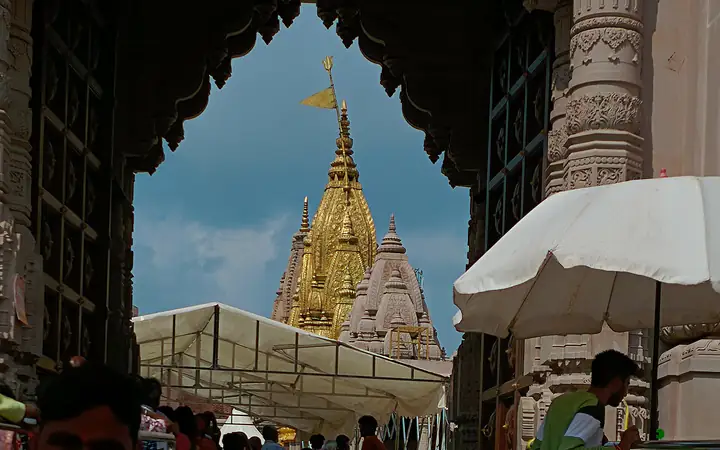
Shiva is worshipped in thousands of temples, but the most sacred are the 12 Jyotirlingas, including Kashi Vishwanath in Varanasi, Somnath in Gujarat, Mahakaleshwar in Ujjain and Kedarnath in the Himalayas.
Other names of Shiva
Shiva has more names than almost any god: the Shiva Sahasranama lists 1,008. These are the ones heard most often in prayers, temple names and everyday speech.
| Name | नाम | Meaning |
|---|---|---|
| Mahadev | महादेव | The great god |
| Bholenath | भोलेनाथ | The innocent lord, so simple he is pleased by a little water and a bel leaf |
| Shankar | शंकर | The one who brings what is good |
| Neelkanth | नीलकंठ | The blue-throated one, who held the halahala poison in his throat to save the world |
| Rudra | रुद्र | The fierce one, his Vedic form |
| Mahakal | महाकाल | The lord of time, and beyond it |
| Mahesh | महेश | The great lord |
| Trilochan | त्रिलोचन | The three-eyed one |
| Gangadhar | गंगाधर | The one who holds the Ganga in his hair |
| Chandrashekhar | चंद्रशेखर | The one who wears the crescent moon |
| Pashupati | पशुपति | The lord of all living beings |
| Nataraj | नटराज | The king of dance, performing the cosmic Tandava |
| Vishwanath | विश्वनाथ | The lord of the universe, as worshipped in Kashi |
Lord Shiva: common questions
Which day is dedicated to Lord Shiva?
Monday (Somvar) is Shiva's day. Many devotees keep a Somvar vrat, especially during the holy month of Sawan (Shravan), and visit a Shiva temple to offer water, milk and bel patra on the Shivling.
What should not be offered to Lord Shiva?
By tradition, tulsi leaves, haldi (turmeric), kumkum and ketaki flowers are not offered to Shiva. Water, milk, bel patra, dhatura, white flowers and bhasm are his favourite offerings.
What are the 12 Jyotirlingas?
The Jyotirlingas are twelve shrines where Shiva is believed to have appeared as a column of light: Somnath, Mallikarjuna, Mahakaleshwar, Omkareshwar, Kedarnath, Bhimashankar, Kashi Vishwanath, Trimbakeshwar, Vaidyanath, Nageshwar, Rameshwaram and Grishneshwar. See our full 12 Jyotirlinga guide.
Why is Shiva called Neelkanth?
During the churning of the ocean (Samudra Manthan) a deadly poison, halahal, rose up and threatened all creation. Shiva drank it to protect the world, and Parvati held his throat so it would not go further. The poison turned his throat blue, and Neelkanth means "the blue-throated one".