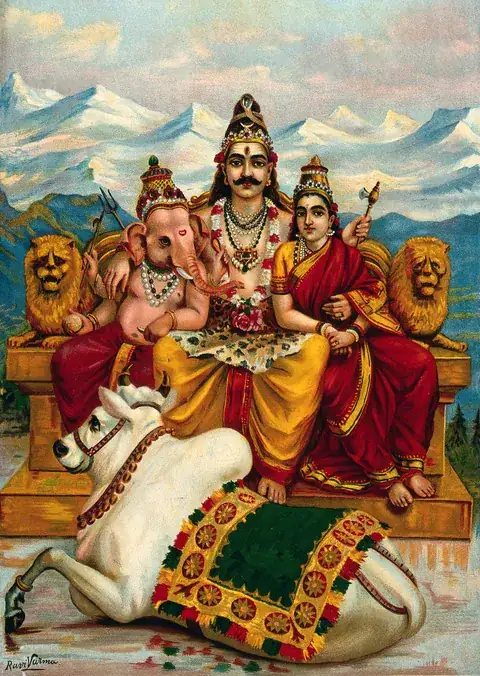
Maha Shivratri, “the great night of Shiva”, is the one night in the year when Shiva devotees stay awake from dusk to dawn. Temples overflow with people carrying lotas of milk and bel leaves, the air is filled with Om Namah Shivaya and Har Har Mahadev, and in homes families sit together through the night, worshipping at every quarter of the dark hours.
It falls on the Chaturdashi of the dark fortnight of Phalgun, usually in February or March, the night before the new moon.
Why Maha Shivratri is celebrated
- Shiva and Parvati’s wedding. The most loved story says this is the night Shiva married Parvati, after her long years of devotion and tapasya. Many unmarried girls fast on Shivratri praying for a husband like Shiva.
- The pillar of light. It is also remembered as the night Shiva appeared as the endless column of light before Brahma and Vishnu, which is the origin of the 12 Jyotirlingas.
- Neelkanth. Some traditions say that on this night Shiva drank the poison from the churning of the ocean to save creation, and the gods kept him awake through the night by singing his praises.
- The hunter’s story. A poor hunter, trapped in a bilva tree all night, dropped leaves and water on a Shivling below without knowing it, and was blessed by Shiva. The lesson: even worship done unknowingly, with a simple heart, reaches him.
How to keep the Shivratri vrat
- The day before, eat a light, sattvic meal.
- On Shivratri morning, bathe early, wear clean clothes, and take a sankalp before Shiva’s picture or Shivling to keep the fast.
- During the day, keep a nirjala fast or a phalahar fast of fruit, milk and vrat foods, as your health allows.
- Visit a Shiva temple if you can, and offer water or milk and bel patra on the Shivling.
- At night, keep awake (jagran) with the family: puja, bhajans, stories of Shiva and chanting.
- Next morning, after bathing and a final puja, break the fast in the parana muhurat.
The four-prahar night puja at home
The night is divided into four prahars of about three hours each, and Shiva is worshipped at the start of each one:
| Prahar | Offering for abhishek |
|---|---|
| First (evening) | Milk |
| Second (late evening) | Curd |
| Third (midnight to early morning) | Ghee |
| Fourth (before dawn) | Honey |
In each prahar:
- Bathe the Shivling with the prahar’s offering while chanting ॐ नमः शिवाय, then with clean water.
- Apply chandan, and offer bel patra, dhatura, white flowers and a little bhasm.
- Offer fruit or a sweet as bhog, and light dhoop and a ghee diya.
- Sing Om Jai Shiv Omkara and spend time in chanting or quiet prayer.
If four prahars are too much, and for elders they often are, a single, unhurried puja at night is perfectly acceptable. Shiva is Bholenath; he values devotion over detail.
What to offer Lord Shiva on Shivratri
Offer: water and Gangajal, milk, curd, ghee, honey, sugar (panchamrit), bel patra, dhatura, aak and white flowers, bhasm, chandan, rudraksha, fruit and ber (jujube, in season).
Avoid: tulsi leaves, haldi, kumkum and ketaki flowers, which by tradition are not offered to Shiva.
Read more about Lord Shiva: his symbols, his mantra and his temples.
Frequently asked questions
Why is Maha Shivratri celebrated?
Maha Shivratri celebrates the night Lord Shiva married Goddess Parvati, the night he appeared as the endless pillar of light (the Jyotirlinga), and, in some traditions, the night he performed the cosmic Tandava dance. It is the most important night of the year for Shiva devotees.
When does Maha Shivratri fall?
Maha Shivratri falls on the Chaturdashi of the dark fortnight of Phalgun (Magha in the Amanta calendar), on the night that Chaturdashi covers midnight. In 2027 that is Saturday, 6 March: Chaturdashi runs from 12:03 PM on 6 March to 1:46 PM on 7 March (New Delhi). Check a local panchang for the four prahar timings in your city.
What can be eaten during the Shivratri fast?
Many devotees keep a nirjala (waterless) fast, but most elders keep a phalahar fast with fruit, milk, curd, makhana, sabudana, singhara or kuttu flour, potatoes and sendha namak. Grains, pulses, onion and garlic are avoided. People with health conditions should fast gently or consult their doctor.
How is the Shivratri fast broken?
The fast is traditionally broken the next morning after sunrise and after the final puja, during the time given in the panchang as the parana muhurat.