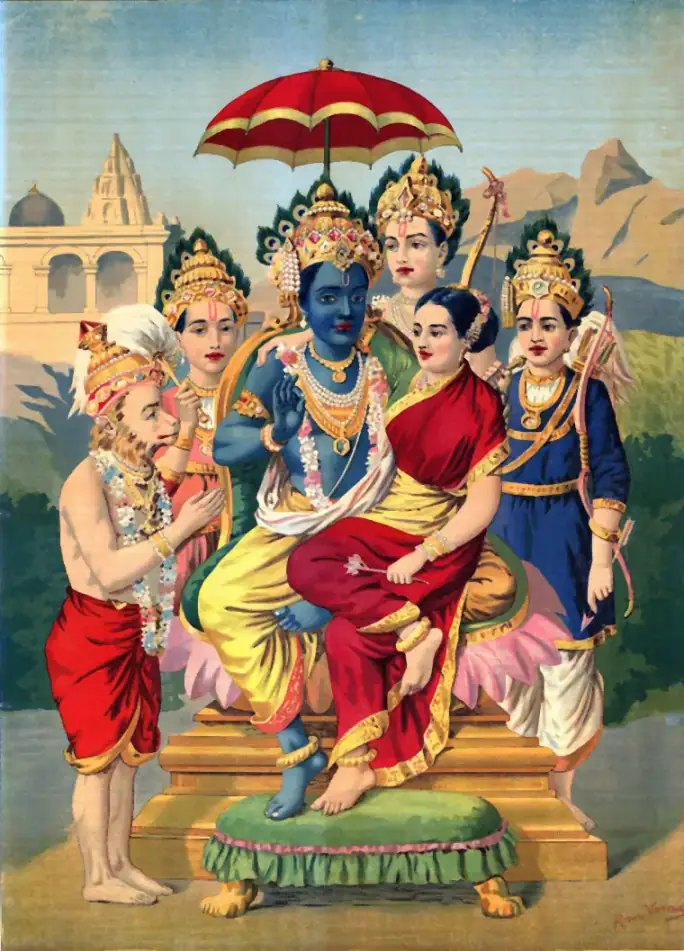
For hundreds of millions of people, Rama is not only a god but the picture of how a good person should live. His story, the Ramayana, has been told for over two thousand years, from Valmiki’s Sanskrit epic to Tulsidas’s Ramcharitmanas in Awadhi, and it is still read aloud in homes and temples across India and the world.
The story of Rama in brief
Rama was born in Ayodhya to King Dasharatha and Queen Kaushalya, the eldest of four brothers with Lakshmana, Bharata and Shatrughna. With the sage Vishvamitra he protected the forest ashrams, and in Mithila he broke the great bow of Shiva to win the hand of Sita, daughter of King Janaka.
On the eve of his coronation, Queen Kaikeyi claimed two old boons from Dasharatha: Bharata would be king, and Rama would go into exile for fourteen years. Rama left without a word of anger, with Sita and Lakshmana beside him. Bharata refused to rule in his place and kept Rama’s sandals on the throne.
In the forest the demon king Ravana carried Sita away to Lanka. With the help of Hanuman, Sugriva and the vanara army, Rama built a bridge across the sea, defeated Ravana, and returned to Ayodhya. The city lit rows of lamps to welcome him home, which is remembered every year at Diwali. His reign, Ram Rajya, became the ideal of a just and happy kingdom.
What Rama teaches
- Keeping your word: he gave up a kingdom rather than let his father break a promise.
- Respect for everyone: he ate the berries offered by the devotee Shabari and embraced the boatman Kevat and the vanaras as friends.
- Dharma before comfort: as son, brother, husband and king, he chose what was right over what was easy.
How to worship Rama at home
- Place a picture of the Ram Darbar (Rama, Sita, Lakshmana and Hanuman) in your puja space.
- Offer yellow flowers, tulsi, fruit and a simple sweet.
- Chant श्री राम जय राम जय जय राम 108 times, or recite the Ram Raksha Stotra.
- Read a few chaupais of the Ramcharitmanas, especially the Sundar Kand on a Tuesday or Saturday.
- End with the aarti “Shri Ramchandra Kripalu Bhaju Man” and the Hanuman Chalisa, since Hanuman is never far from Rama.
Festivals and famous temples
Ram Navami marks his birth, Vijayadashami (Dussehra) his victory over Ravana, and Diwali his return to Ayodhya. Important Rama temples include the Shri Ram Janmabhoomi Mandir and Kanak Bhawan in Ayodhya, Ramanathaswamy in Rameswaram (where Rama is said to have worshipped Shiva), Bhadrachalam in Telangana, Kalaram Mandir in Nashik and Ram Raja Mandir in Orchha, where Rama is worshipped as a king.
Other names of Rama
Rama’s name itself is considered a complete mantra. The Rama Ashtottara lists 108 names; these are the ones heard in the Ramayana and in bhajans.
| Name | नाम | Meaning |
|---|---|---|
| Ramchandra | रामचंद्र | Rama, lovely as the moon |
| Raghav | राघव | The descendant of Raghu |
| Raghunandan | रघुनंदन | The joy of the Raghu clan |
| Raghupati | रघुपति | The lord of the Raghus |
| Dasharathi | दाशरथि | The son of Dasharatha |
| Kaushalya Nandan | कौशल्यानंदन | The son of Kaushalya |
| Siyavar | सियावर | The husband of Sita |
| Janaki Vallabh | जानकीवल्लभ | The beloved of Janaki (Sita) |
| Maryada Purushottam | मर्यादा पुरुषोत्तम | The best of men, who never crossed the bounds of dharma |
| Kodandapani | कोदंडपाणि | The one who holds the Kodanda bow |
| Awadhesh | अवधेश | The lord of Awadh (Ayodhya) |
Lord Rama: common questions
When is Ram Navami?
Ram Navami is Lord Rama's birthday, celebrated on the Navami (ninth day) of Shukla Paksha in the month of Chaitra, usually in March or April. It is the last day of Chaitra Navratri. Rama is believed to have been born at midday, so the main puja is held around noon.
Why is Rama called Maryada Purushottam?
Maryada Purushottam means "the best of men who keeps within the bounds of right conduct". Rama gave up his throne to honour his father's word, lived fourteen years in the forest without complaint, and ruled as a just king. He is the model of duty, truthfulness and self-control.
What is the Rama Panchayatan?
The Rama Panchayatan is the family of five (or six) shown together in worship: Rama and Sita enthroned, with Lakshmana, Bharata and Shatrughna, and Hanuman seated at their feet. It is the form painted above and the most common image of the Ram Darbar in homes and temples.
Is chanting "Ram" enough?
Many saints, from Tulsidas to Kabir, taught that simply repeating Rama's name with love is a complete spiritual practice. The thirteen-syllable mantra "Shri Ram Jai Ram Jai Jai Ram" is chanted on a mala, and the name "Ram" is written in notebooks as Ram naam lekhan.