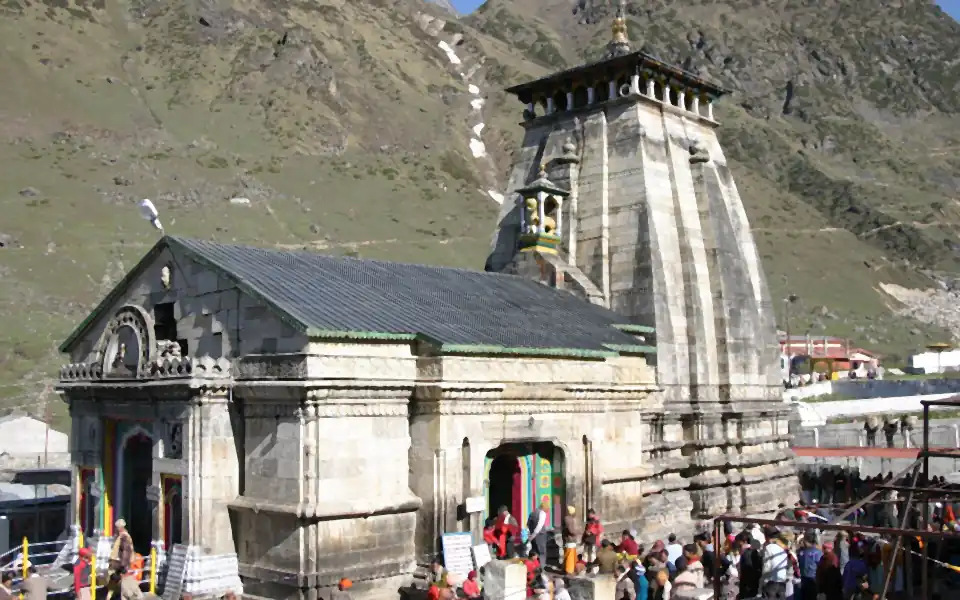
Uttarakhand is called Devbhoomi, the land of the gods. It holds the sources of the Ganga and the Yamuna, the Himalayan abodes of Shiva at Kedarnath and Vishnu at Badrinath, and more pilgrimage circuits than any other state: the Char Dham, the Panch Kedar, the Panch Badri and the Panch Prayag. The state divides into two regions: Garhwal in the west, with the Char Dham, Haridwar and Rishikesh, and Kumaon in the east, with Jageshwar, Nainital and Kainchi Dham.
Uttarakhand’s great temples at a glance
| Temple | Place | Deity | Why it matters |
|---|---|---|---|
| Kedarnath | Rudraprayag, 3,583 m | Shiva | One of the 12 Jyotirlingas; Char Dham |
| Badrinath | Chamoli, 3,133 m | Vishnu (Badri Narayan) | Char Dham in both lists; on the Alaknanda |
| Yamunotri | Uttarkashi | Goddess Yamuna | Source of the Yamuna; first stop of the Char Dham |
| Gangotri | Uttarkashi | Goddess Ganga | Where the Ganga descended; second stop |
| Tungnath | Rudraprayag, ~3,680 m | Shiva | Highest Shiva temple in the world; Panch Kedar |
| Har Ki Pauri | Haridwar | Ganga | Evening Ganga aarti; Kumbh Mela ghat |
| Mansa Devi & Chandi Devi | Haridwar | Shakti | Hilltop goddess temples, reached by ropeway |
| Neelkanth Mahadev | near Rishikesh | Shiva | Where Shiva held the halahala poison |
| Jageshwar | Almora | Shiva | A group of over 100 stone temples, 9th–13th century |
| Kainchi Dham | Nainital | Hanuman | Neem Karoli Baba’s ashram |
| Naina Devi | Nainital | Shakti | On the lake shore; a Shakti Peetha tradition |
| Golu Devta (Chitai) | Almora | Golu Devta | Thousands of bells hung by grateful devotees |
| Baijnath | Bageshwar | Shiva | 12th-century Katyuri temple on the Gomti |
| Purnagiri | Champawat | Shakti | Hilltop shrine above Tanakpur; spring mela |
| Dhari Devi | Srinagar (Garhwal) | Kali | Guardian goddess of the Char Dham |
The Char Dham yatra
The Chota Char Dham is the most important pilgrimage in Uttarakhand, and one of the most important in India. Pilgrims traditionally go from west to east: Yamunotri → Gangotri → Kedarnath → Badrinath.
- Yamunotri is reached by a 6 km walk (or pony and palki) from Janki Chatti. Pilgrims cook rice in the hot spring of Surya Kund as prasad.
- Gangotri is on a motorable road. The actual source, Gaumukh glacier, is an 18 km trek beyond and needs a permit.
- Kedarnath is a 16 km trek from Gaurikund, or a short helicopter ride from Phata, Guptkashi or Sersi.
- Badrinath is on the road, beside the hot springs of Tapt Kund. Mana, the last village before Tibet, is 3 km away.
Season: the shrines open around Akshaya Tritiya (April or May) and close for winter around Diwali. Kedarnath and Yamunotri usually close on Bhai Dooj, Gangotri the day after Diwali, and Badrinath in mid-November. Avoid July and August, the monsoon months, when landslides close roads. Registration with Uttarakhand Tourism is compulsory; carry a printout and photo ID. A full Char Dham by road needs 10 to 12 days from Haridwar.
Panch Kedar: Shiva in five places
After the Mahabharata war, the story goes, the Pandavas sought Shiva’s forgiveness. He avoided them by taking the form of a bull and sinking into the earth; parts of him appeared in five places, now the Panch Kedar:
- Kedarnath: the hump
- Tungnath: the arms (the highest Shiva temple, a 3.5 km walk from Chopta)
- Rudranath: the face (a long, steep trek)
- Madhyamaheshwar: the navel
- Kalpeshwar: the hair (the only one open all year)
Panch Prayag: where the rivers meet
The Alaknanda meets five rivers on its way down to form the Ganga, and each confluence (prayag) is sacred: Vishnuprayag (Dhauliganga), Nandprayag (Nandakini), Karnaprayag (Pindar), Rudraprayag (Mandakini) and Devprayag, where the Alaknanda and Bhagirathi join and the river first takes the name Ganga. You pass all five on the road to Badrinath.
Haridwar and Rishikesh
Haridwar, “the gateway to Hari”, is where the Ganga leaves the mountains. The evening Ganga aarti at Har Ki Pauri is one of the great sights of India, and the city hosts the Kumbh Mela every twelve years. Take the ropeways to Mansa Devi and Chandi Devi on the hills either side.
Rishikesh, 25 km upstream, is the yoga capital of the world. Watch the evening aarti at Triveni Ghat or Parmarth Niketan, cross the river on Ram Jhula, and drive 32 km into the hills to Neelkanth Mahadev, where Shiva is said to have held the poison from the churning of the ocean in his throat.
Kumaon: the quieter temples
Jageshwar, 36 km from Almora, is a valley of more than a hundred stone temples under tall deodar trees, built between the 9th and 13th centuries; many devotees revere it as a Jyotirlinga. Kainchi Dham, Neem Karoli Baba’s Hanuman ashram near Bhowali, draws millions since his story reached the screen (read about Neem Karoli Baba’s life). The Naina Devi temple sits on Nainital’s lake; Golu Devta at Chitai near Almora is hung with thousands of bells left by devotees whose prayers were answered; Baijnath in Bageshwar is a graceful 12th-century temple on the Gomti; and the cave temple of Patal Bhuvaneshwar in Pithoragarh is entered by a narrow passage deep underground.
When to go
| Season | Months | Good for |
|---|---|---|
| Spring | March–April | Haridwar, Rishikesh, Kumaon; Char Dham opens late April/May |
| Summer | May–June | Char Dham (busiest); Kainchi mela on 15 June |
| Monsoon | July–August | Avoid the high mountains; landslides close roads |
| Autumn | September–November | Clear skies; the best time for Char Dham and Kumaon |
| Winter | December–February | Haridwar, Rishikesh and Kumaon only; high shrines are closed |
Travelling with elders
- Kedarnath and Yamunotri involve long treks at altitude. Ponies, palkis and helicopters make them possible for many elders, but get a doctor’s advice on altitude first.
- Badrinath and Gangotri are reachable by road, the gentlest of the four for older pilgrims.
- Build in rest days. Hill roads are slow; 150 km can take seven hours.
- Kumaon is easier: Kainchi, Jageshwar and Nainital are on good roads at comfortable heights.
Sources: Uttarakhand Tourism and the Badrinath–Kedarnath Temple Committee announcements; the Archaeological Survey of India for Jageshwar and Baijnath; Wikipedia for altitudes. Opening dates change every year; please check the official announcement before you book.
Uttarakhand temples: common questions
What is the Char Dham of Uttarakhand?
The Chota Char Dham are the four Himalayan shrines of Yamunotri (Goddess Yamuna), Gangotri (Goddess Ganga), Kedarnath (Lord Shiva) and Badrinath (Lord Vishnu). They are traditionally visited from west to east in that order, and are open only from about April or May to October or November.
When do the Char Dham temples open and close?
The shrines open around Akshaya Tritiya (April or May) and close for winter around Diwali. Kedarnath and Yamunotri usually close on Bhai Dooj, Gangotri on the day after Diwali, and Badrinath in mid-November. Exact dates are announced by the temple committees each year, and online registration with Uttarakhand Tourism is required.
Which is the highest Shiva temple in the world?
Tungnath, one of the Panch Kedar in Rudraprayag district, stands at about 3,680 metres and is considered the highest Shiva temple in the world. Kedarnath is at about 3,583 metres.
Why is Uttarakhand called Devbhoomi?
Devbhoomi means "land of the gods". The sources of the Ganga and Yamuna, the abodes of Shiva at Kedarnath and Vishnu at Badrinath, and countless sages' ashrams are all in these mountains, so the whole state is regarded as sacred ground.
Where is Kainchi Dham?
Kainchi Dham, Neem Karoli Baba's Hanuman ashram, is in Nainital district on the Nainital–Almora road, 17 km from Nainital and 37 km from Kathgodam railway station.