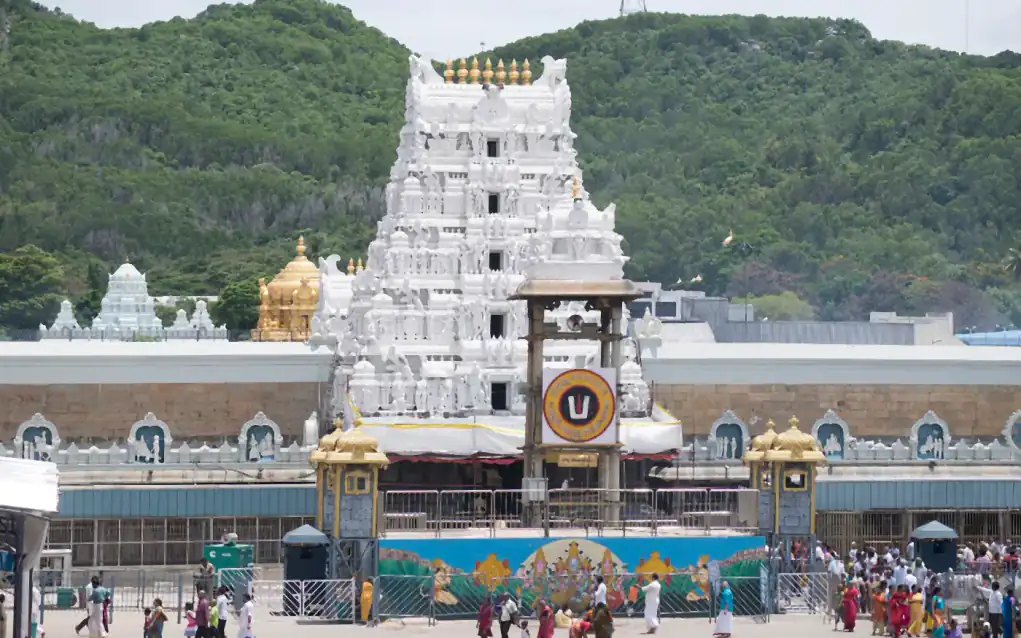
Every day, tens of thousands of pilgrims climb to the top of the Seshachalam hills to stand for a few seconds before Lord Venkateswara. For many families a trip to Tirupati is a lifelong promise, a vow made during a difficult time and fulfilled with gratitude. It is one of the most visited and most generously supported places of worship anywhere in the world.
Who is Lord Venkateswara?
Venkateswara, also called Balaji, Srinivasa and Govinda, is a form of Lord Vishnu. According to the legend, Vishnu came down to the Venkata hill in search of Goddess Lakshmi, took the form of Srinivasa and married Padmavati, daughter of a local king. To pay for the wedding he borrowed a great sum from Kubera, the treasurer of the gods, and devotees say the offerings in Tirumala’s hundi help him repay that loan to this day.
The temple
The temple stands on Venkatadri, one of the seven peaks of the Tirumala hills, which are said to represent the seven hoods of Adishesha, the serpent on which Vishnu rests. The sanctum’s gold-plated tower is called the Ananda Nilayam. The temple has been worshipped in for well over a thousand years and was richly endowed by the Pallava, Chola, Pandya and Vijayanagara kings, especially Krishnadevaraya. Today it is managed by the Tirumala Tirupati Devasthanams (TTD).
Types of darshan
- Sarva Darshan: free, no booking; waiting can be long, from a few hours to a full day at peak times.
- Special Entry Darshan (₹300): booked online in advance for a fixed time slot.
- Senior citizen and differently-abled darshan: special slots with a separate entry.
- Divya Darshan: for those who climb on foot by the Alipiri or Srivari Mettu paths.
- Arjitha Sevas: paid rituals such as Suprabhatam and Kalyanotsavam, booked through TTD.
Book only through the official TTD website or app, and be careful of unofficial agents.
Traditions to know
- Tonsure: many pilgrims offer their hair as a sign of surrender at the Kalyana Katta.
- Tirupati laddu: the famous laddu prasad has a Geographical Indication (GI) tag. Each devotee receives one free laddu after darshan, and more can be bought at the counters.
- Padmavati Temple: tradition says a pilgrimage is complete only after visiting Goddess Padmavati’s temple at Tiruchanur, near Tirupati.
Tips for elderly visitors
- Book senior-citizen darshan in advance on the TTD website.
- Take the bus or a taxi up the ghat road rather than climbing.
- Carry light woollens in the winter months; Tirumala is cooler than Tirupati.
- Keep ID proof handy. It’s checked at several points.
- Free annaprasadam (meals) is served at the Matrusri Tarigonda Vengamamba Annaprasadam complex.
At home, you can offer your prayers to Balaji with the aarti Om Jai Jagdish Hare.
Sri Venkateswara Temple, Tirumala: common questions
How do I book darshan at Tirupati Balaji?
Darshan tickets, including Special Entry Darshan (₹300) and slots for senior citizens, are booked on the official Tirumala Tirupati Devasthanams (TTD) website or app. Free Sarva Darshan is also available without booking, but waiting times can be many hours. Always use the official TTD channels.
Is there special darshan for senior citizens at Tirumala?
Yes. TTD offers special darshan slots for senior citizens above 65 and for differently-abled devotees, usually with a separate entry and shorter wait. The rules and quotas change from time to time, so check the official TTD website before planning.
What is the dress code at Tirumala temple?
Traditional Indian dress is required for darshan. Men should wear a dhoti with an upper cloth or kurta-pyjama; women should wear a saree, half-saree or churidar with a dupatta. Jeans, shorts and T-shirts are not allowed for most darshans.
Why do devotees offer their hair at Tirupati?
Offering one's hair (tonsure) is an act of surrender, giving up ego and vanity before the Lord. It is also linked to the legend of Neela Devi, who offered her own hair to Lord Venkateswara. Free tonsuring is available at the Kalyana Katta halls.
How long does it take to walk up to Tirumala?
The Alipiri footpath has about 3,500 steps and takes most people 3 to 5 hours. The Srivari Mettu path is shorter, about 2,400 steps, taking 1.5 to 3 hours. Elderly devotees usually take the bus or a taxi up the ghat road.